
statsmodels.graphics.regressionplots.plot_ccpr_grid#
- statsmodels.graphics.regressionplots.plot_ccpr_grid(results, exog_idx=None, grid=None, fig=None)[source]#
Generate CCPR plots against a set of regressors, plot in a grid
Generates a grid of component and component-plus-residual (CCPR) plots.
- Parameters:
- results
resultinstance A results instance with exog and params.
- exog_idx
list[int]orlist[str],optional The indices or column names of the exog used in the plot.
- grid
tuple[int],optional If grid is given, then it is used for the arrangement of the subplots. The format of grid is (nrows, ncols). If grid is None, then ncol is one, if there are only 2 subplots, and the number of columns is two otherwise.
- fig
Figure,optional If given, this figure is simply returned. Otherwise a new figure is created.
- results
- Returns:
FigureIf ax is None, the created figure. Otherwise the figure to which ax is connected.
See also
plot_ccprCreates CCPR plot for a single regressor.
Notes
Partial residual plots are formed as:
Res + Betahat(i)*Xi versus Xi
and CCPR adds:
Betahat(i)*Xi versus Xi
References
See http://www.itl.nist.gov/div898/software/dataplot/refman1/auxillar/ccpr.htm
Examples
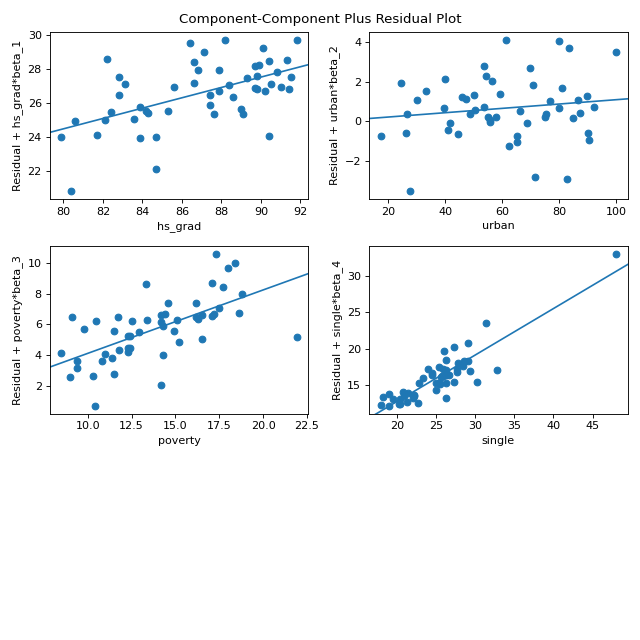
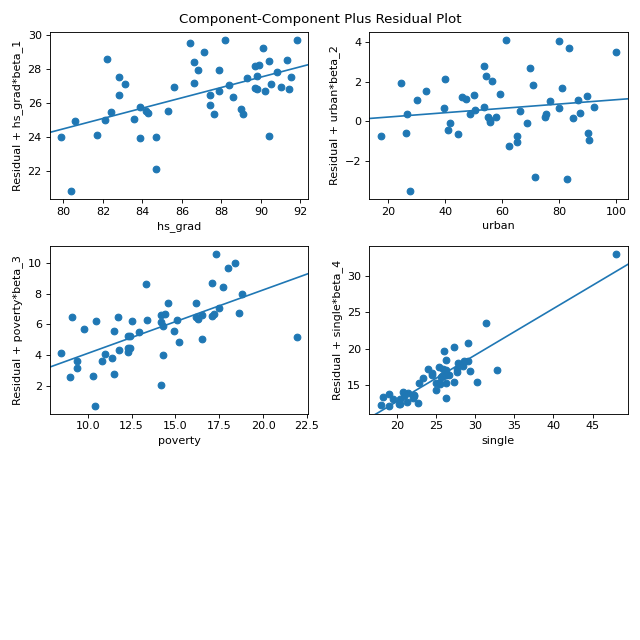
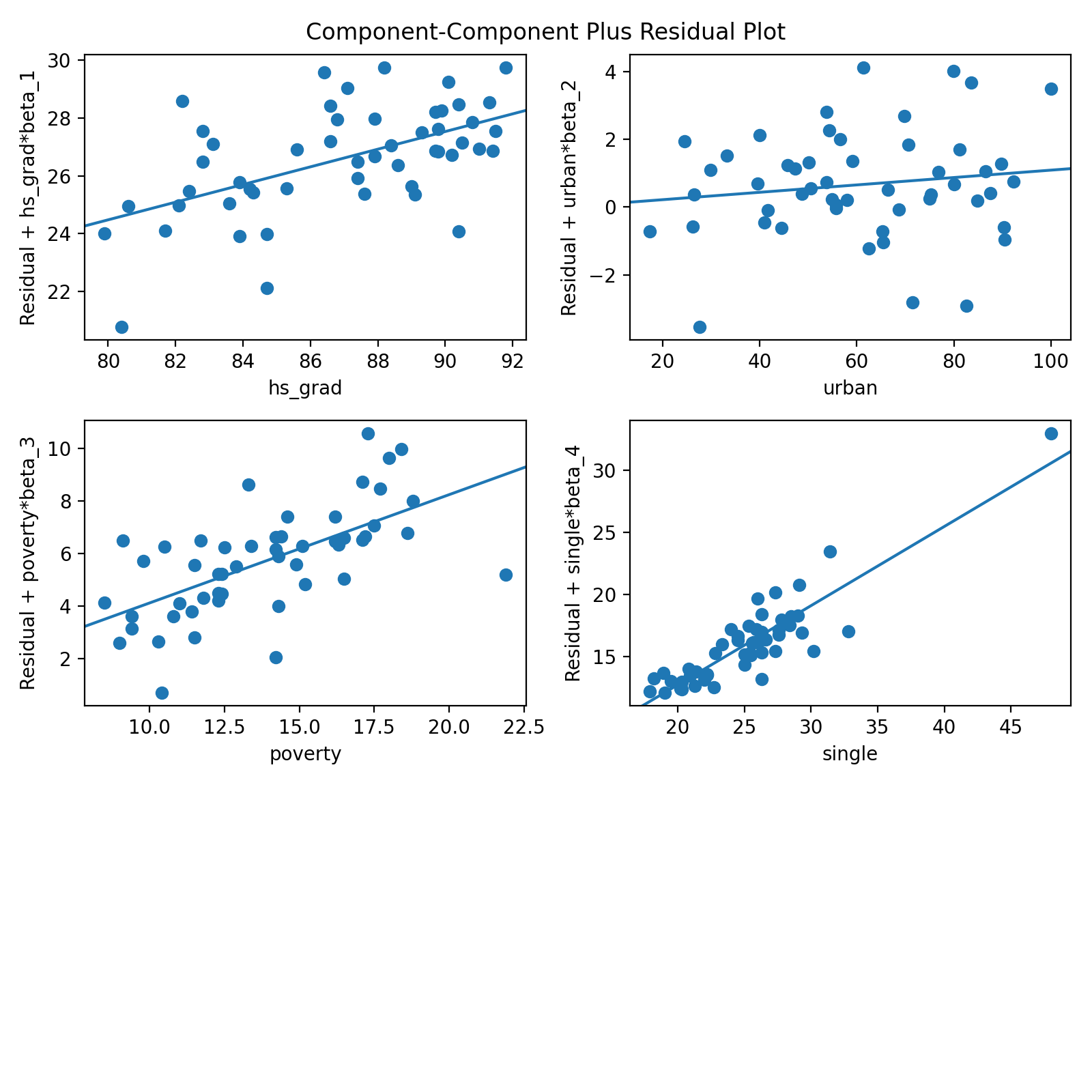
Using the state crime dataset separately plot the effect of each variable on the outcome, murder rate, while accounting for the effect of all other variables in the model.
>>> import statsmodels.api as sm
>>> import statsmodels.formula.api as smf
>>> fig = plt.figure(figsize=(8, 8))
>>> crime_data = sm.datasets.statecrime.load_pandas()
>>> results = smf.ols('murder ~ hs_grad + urban + poverty + single',
...                   data=crime_data.data).fit()
>>> sm.graphics.plot_ccpr_grid(results, fig=fig)
>>> plt.show()
(
Source code,png,hires.png,pdf)